
interview question of anthrapic
Question 1: Concurrent Web Crawler Implementation
Design and implement a multi-threaded web crawler that efficiently crawls a specific domain and counts unique URLs
Requirements:
- Handle circular references and invalid URLs
- implement rate limiting and exponential back off
- Process robots.txt compliance
- Support different URL schemes and redirects
- Optimize for memory usage with large datasets
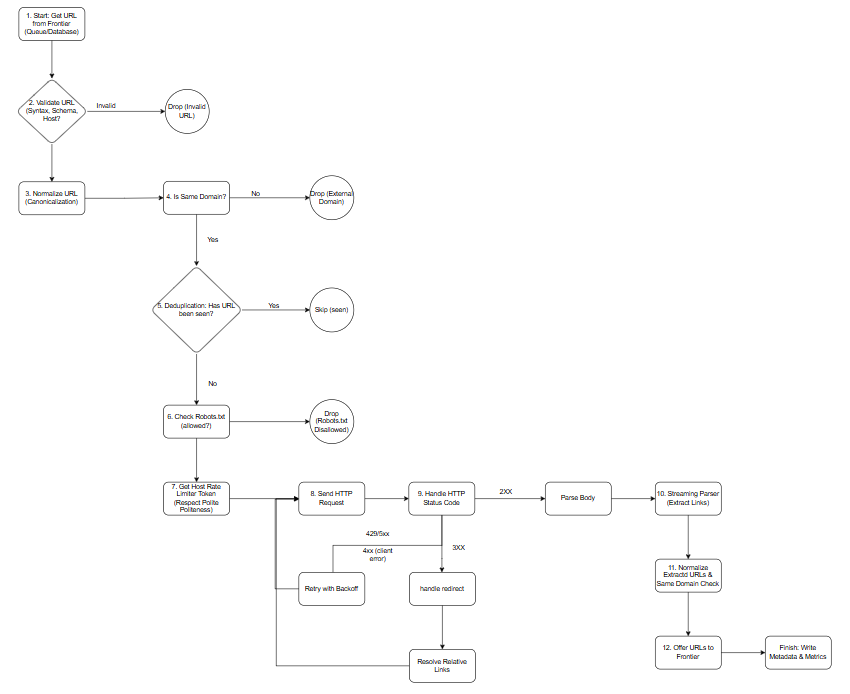
Overview
1 | [Seed URLs] |
Frontier
1 | function offer(url): |
The Frontier is the URL scheduling center. To control the memory usage, I use a bounded in-memory queue to store active tasks, and RocksDB or files as an overflow queue. When the in-memory queue is empty, I load URLs in batches from the persistent queue, avoiding loading a massive number of URLs in to memory at once.
Worker Pool
1 | while running: |
Since crawling is I/O bound, I would use a fixed-size worker pool. The number of threads should be configurable and combined with per-host rate limiting, so concurrency improve throughput without violating politeness rules.
Seen (BloomFilter + RocksDB)
1 | if bloom.mightContain(url): |
For correctness under concurrency, deduplication must be atomic. A simple contains-then-put can cause race conditions, so I would use put-if-absent semantics or protect the check-and-insert operation with lock striping.
URL Normalization
1 | def normalize(u): |
- unify scheme and host to lowercase
- remove default ports (80 for http, 443 for https)
- sort query parameters and remove tracking parameters
- normalize path (remove dot segments, trailing slashes)
URL canonicalization is essential for deduplication. Without it, the crawler may crawl the same resource many times under slightly different URL forms.
isValid
1 | def isValid(url): |
I would reject unsupported schemes such as mailto, javascript and tel, and only allow HTTP/HTTPS URLs. I would also validate host, path, URL length, and optionally block private IP ranges for security.
Robots.txt
1 | if not robotsCache.has(host): |
Robots rules should be cached per host with TTL. Before fetching a URL, each worker checks whether the path is allowed for the configured user agent. Crawl-delay should be translated into a per-host request rate.
Rate Limiter
1 | lim = hostLimit.computeIfAbsent(host, h -> new TokenBucket(defaultRate, burst)) |
A per-host token bucket ensures politeness. Even if we have many worker threads, requests to the same host are throttled independently.
HTTP Fetcher
1 | def handle_request_stream(url): |
- 200 OK -> parse HTML
- 301 Moved Permanently -> redirect to new URL
- 302 Found -> redirect to new URL
- 404 Not Found -> record and skip
- 429 Too Many Requests -> decrement rate limit and retry with backoff
- 500/502/503/504 -> retry with backoff
I would only parse response with HTML content type and enforce timeouts and max body size to avoid downloading huge files.
Redirect Handler
- parse redirect URL from Location header
- resolve relative path to absolute path based on the original URL
- normalize the absolute path
- check again whether the domain is the same
- check robots.txt again for the new URL
- limit the number of redirects to avoid infinite loops (e.g., max 5 redirects)
Redirects should be followed up to a configured maximum depth (e.g., 5). Each redirect URL should be normalized and checked against the seen set to avoid infinite loops. If a redirect points to a different domain, it should be treated as a new URL and processed accordingly.
Exponential Backoff + Jitter
sleep = base * 2^attempt + random(0, jitter)
1 | for attempt in 0..max: |
I would retry only transient failures such as 429, 5xx and network timeouts. The retry delay uses exponential backoff with full jitter to prevent retry storms.
Parser
1 | for link in streamingParse(htmlStream): |
I would use a streaming HTML parser and avoid storing full page content. The crawler only stores metadata and extracted links.
Same Domain
Only crawl URLs that belong to the same domain as the seed URL. This prevents the crawler from wandering off into unrelated sites.
For example, if the seed URL is https://example.com, the crawler should only follow links that resolve to example.com or its subdomains.1
2
3https://example.com/a
https://www.example.com/b // check subdomain, allow
https://blog.example.com/c // check subdomain, allow
Storage
Storage: only metadata (URL, status, timestamp)
Monitor
Prometheus metrics + Grafana dashboards1
2
3
4
5
6
7
8
9
10
11
12
13
14
15frontier_queue_size
persistent_queue_size
active_workers
fetch_success_count
fetch_failure_count
retry_count
redirect_count
robots_blocked_count
unique_url_count
duplicate_url_count
per_host_request_rate
average_fetch_latency
p95_fetch_latency
memory_usage
rocksdb_write_latency
Question 2: Distributed LLM Inference System Design
Design a high-throughput system for serving large language model inference requests at scale.
Requirements:
- Support 15,000+ requests per second
- Handle multiple model variants and sizes
- Implement dynamic load balancing
- Achieve sub0100ms latency for standard requests
- Support zero-downtime model updates
- Include comprehensive monitoring and alerting
Question 3: High-Performance Document Similarity Search
Implement an efficient algorithm for finding top-k most similar documents from a massive corpus
Requirements:
- Handle 15M+ document corpus
- Average document length: 1500+ words
- Query response time: < 30 ms
- Support real-time document additions
- Optimize memory footprint
Question 4: Distributed System Debugging Challenge
Debug a meesage queue system experiencing performance degradation under high load
Common Issues:
- Race conditions in concurrent message processing
- Memory leaks from unclosed connections
- Improper error handling causing silent failures
- Inefficient connection pooling strategies
- Deadlocks in multi-threaded environment
Question 5: Real-time Data Processing Pipeline
Design a system for processing streaming data with low latency and high reliability.
Requirements:
- Process 100,000+ events per second
- Maintain exactly-once processing semantics
- Support complex event transformations
- Handle out-of-order events
- Implement fault tolerance and recovery
Question 6: Machine Learning Model Serving Optimization
Optimize an existing ML model serving system for better performance and resource utilization
Focus Areas:
- Batch processing optimization
- GPU memory management
- Model parallelism strategies
- Caching mechanisms for predictions
- Auto-scaling based on demand
Question 7: Database Performance Tuning
Analyze and optimize a database system experiencing slow query performance.
Common Problems:
- Missing or inefficient indexes
- Poor query optimization
- Lock contention issues
- Inadequate connection pooling
- Suboptimal schema design