
Derivative
Derivative
The derivative is a fundamental concept in calculus. The derivative of a function at a specific point represents the rate of change of the function near that point (i.e., the slope of the tangent line to the function’s graph at that point). The essence of a derivative is to provide a local linear approximation of a function using the concept of limits.
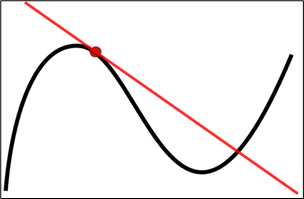
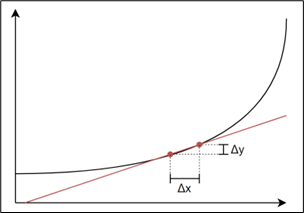
When the independent variable of function $f(x)$ produces an increment $\Delta x$ at point $x_0$, if the limit of the ratio between the function value increment $\Delta y$ and the variable increment $\Delta x$ exists as $\Delta x \to 0$, it is called the derivative of $f(x)$ at $x_0$, denoted as $f’(x_0)$, $y’$, or $\frac{dy}{dx}$.
Example: In kinematics, the derivative of an object’s displacement with respect to time is its instantaneous velocity: $v = \frac{ds}{dt}$.
Derivatives of Basic Functions
| Description | Formula | Example |
|---|---|---|
| Constant | $\frac{d}{dx}c = 0$ | $\frac{d}{dx}5 = 0$ |
| Power Function | $\frac{d}{dx}x^n = nx^{n-1}$ | $\frac{d}{dx}x^3 = 3x^2$ |
| Exponential | $\frac{d}{dx}e^x = e^x$ | — |
| Exponential (General) | $\frac{d}{dx}a^x = a^x \ln a$ | $\frac{d}{dx}2^x = 2^x \ln 2$ |
| Logarithm (Natural) | $\frac{d}{dx}(\ln x) = \frac{1}{x}$ | — |
| Logarithm (General) | $\frac{d}{dx}(\log_a x) = \frac{1}{x \ln a}$ | $\frac{d}{dx}(\log_{10} x) = \frac{1}{x \ln 10}$ |
| Sine | $\frac{d}{dx}(\sin x) = \cos x$ | — |
| Cosine | $\frac{d}{dx}(\cos x) = -\sin x$ | — |
| Tangent | $\frac{d}{dx}(\tan x) = \sec^2 x$ | — |
| Cotangent | $\frac{d}{dx}(\cot x) = -\csc^2 x$ | — |
Differentiation Rules
| Description | Formula |
|---|---|
| Sum Rule | $(u \pm v)’ = u’ \pm v’$ |
| Product Rule | $(uv)’ = u’v + uv’$ |
| Quotient Rule | $(\frac{u}{v})’ = \frac{u’v - uv’}{v^2}$ |
| Chain Rule | $\frac{dy}{dx} = \frac{dy}{du} \cdot \frac{du}{dx}$ |
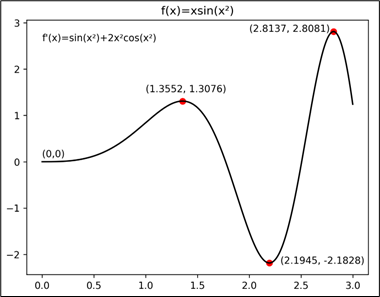
Example: Find the derivative of $y = \sin(x^2)$ at $x$.
Applying the Chain Rule: $y’ = \cos(x^2) \cdot (x^2)’ = 2x \cos(x^2)$.
Finding Extrema Using Derivatives
Points where the derivative equals zero ($f’(x) = 0$) are called stationary points (or critical points). At these points, the function may achieve a local maximum or minimum. Further judgment requires analyzing the sign of the derivative in the neighborhood of these points.
The Second Derivative
In calculus, the second derivative is the derivative of the derivative of a function. Roughly speaking, it describes how the rate of change of a quantity is itself changing. For example, the second derivative of an object’s position with respect to time is its instantaneous acceleration:
The second derivative of $f(x)$ is usually denoted as $f’’(x)$, $y’’$, or $\frac{d^2y}{dx^2}$.
Relationship with Concavity
The second derivative describes the direction and degree of the function’s curvature:
- If $f’’(x) > 0$ on an interval, the function is concave up (upward bend).
- If $f’’(x) < 0$ on an interval, the function is concave down (downward bend).
- An inflection point occurs where the second derivative changes sign. If the second derivative is continuous, it must be 0 at the inflection point (though $f’’(x)=0$ does not always guarantee an inflection point, e.g., $y=x^4$).
Second Derivative Test for Extrema:
- If $f’(x_0) = 0$ and $f’’(x_0) < 0$, then $f(x_0)$ is a Local Maximum.
- If $f’(x_0) = 0$ and $f’’(x_0) > 0$, then $f(x_0)$ is a Local Minimum.
- If $f’(x_0) = 0$ and $f’’(x_0) = 0$, the point could be an inflection point or an extremum.
Partial Derivatives and Gradients
Partial Derivatives
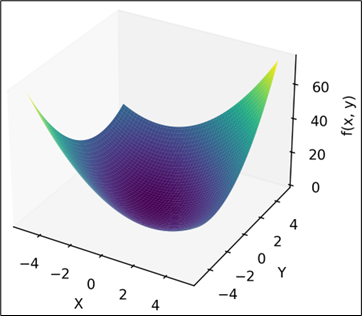
If a function $f$ has multiple independent variables (e.g., $z = f(x, y)$), we can treat one variable (say $y$) as a constant. Then $f$ can be viewed as a function of the other variable $x$ alone.
The derivative of $f$ with respect to $x$ while holding $y$ constant is called the partial derivative, denoted as:
More generally, the partial derivative of a multivariable function $f(x_1, x_2, \dots, x_n)$ with respect to $x_i$ at point $(x_1, \dots, x_n)$ is defined as:
Gradient
A multivariable function $f$ has partial derivatives $\frac{\partial f}{\partial x_i}$ for each variable. At a specific point, these partial derivatives form a vector:
This vector is called the gradient of $f$.
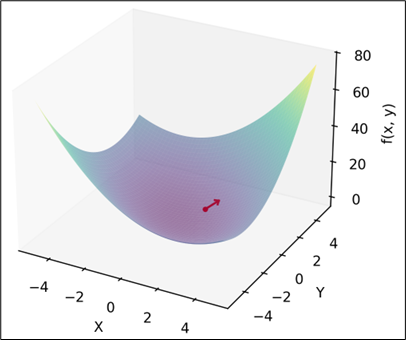
Example: The gradient of $f(x, y) = x^2 + y^2$ is $\nabla f = (2x, 2y)$.
At point $(1, 2)$, the gradient is $(2, 4)$.