Repair Management System
The Repair Management System upgrade project was initiated to modernize the company’s internal repair workflow and improve coordination between business, logistics, and store teams.
The system supports the full repair process, including repair order creation, task handling, repair completion, item transfer, and repair form printing. Business staff can create repair orders based on product tags or item details, while logistics and store teams can track, process, and complete repair tasks more efficiently.
The original system relied heavily on complex SQL Server stored procedures, which made the business logic difficult to maintain, test, and extend. To address these issues, the project focused on refactoring legacy logic into independent backend modules, improving system maintainability, performance, and long-term scalability.
By digitizing and standardizing repair operations, the upgraded system improved workflow efficiency, process traceability, and cross-department collaboration.
Project Background
Before the upgrade, the repair process involved multiple teams and several manual coordination steps. Repair-related business logic was tightly coupled with database stored procedures, which increased maintenance difficulty and slowed down future development.
The upgrade aimed to:
- Standardize the repair order management process.
- Improve collaboration between business, logistics, and store teams.
- Refactor stored procedure logic into maintainable backend service modules.
- Improve system performance and reduce development complexity.
- Provide better traceability for repair tasks and item transfers.
- Support future business expansion through a cleaner system architecture.
Core Features
Repair Order Management
Supports repair order creation, repair request tracking, and repair status management.Repair Task Completion
Allows users to record, verify, and complete repair tasks.Repair Form Printing
Supports repair form generation and printing for operational use.Item Transfer
Manages the transfer of repaired items to local stores, branches, or other business locations.Workflow Tracking
Provides better visibility into repair progress, responsible teams, and task status.
System Architecture
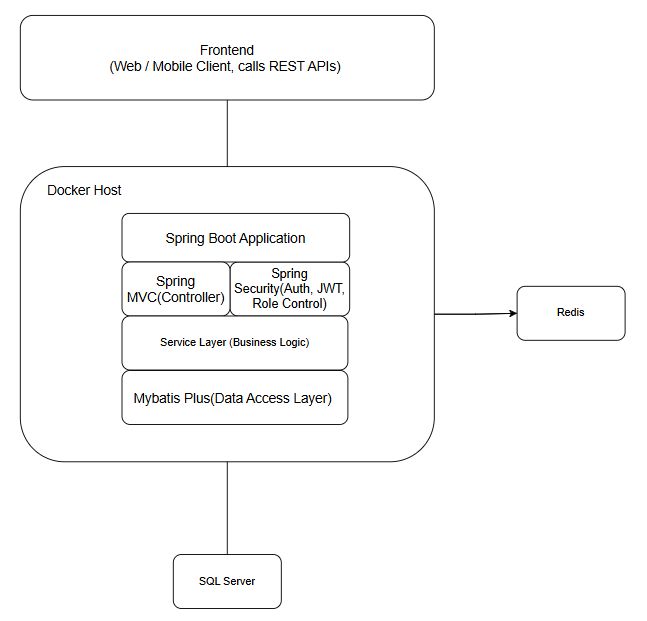
The upgraded system adopted a Java-based backend architecture with Spring Boot, MyBatis Plus, Redis, RabbitMQ, SQL Server, Docker, and a Vue 2 frontend. The architecture helped separate business logic from database stored procedures and made the system easier to maintain and extend.
My Role
In this project, I was responsible for analyzing the upgrade workload, planning the system refactoring approach, assigning development tasks, guiding junior engineers, and contributing to key feature development.
I also supported code review, issue troubleshooting, project progress tracking, and technical documentation.
Personal Contributions
Legacy Logic Refactoring
- Analyzed the original system’s complex SQL Server stored procedures.
- Refactored stored procedure logic into independent backend service modules.
- Improved code readability, maintainability, and testability.
- Helped reduce system dependency on database-side business logic.
Repair Business Feature Development
- Developed key repair workflow features, including repair order creation, repair task completion, and repair form printing.
- Implemented backend APIs to support repair order processing and status updates.
- Supported item transfer workflows between stores, branches, and logistics teams.
- Helped improve the traceability and efficiency of repair operations.
Project Planning and Task Coordination
- Analyzed the overall upgrade scope and estimated the development workload.
- Planned development tasks based on system modules and business priorities.
- Assigned tasks according to junior engineers’ experience levels.
- Tracked development progress and helped ensure project delivery according to schedule.
Technical Guidance and Code Review
- Provided technical guidance to junior engineers during implementation.
- Reviewed code written by team members to ensure quality, consistency, and maintainability.
- Helped resolve development issues related to backend logic, database integration, API design, and system behavior.
- Supported troubleshooting during development, testing, and integration phases.
Documentation
- Prepared interface documentation for frontend-backend integration.
- Created testing reports to validate business workflows and system behavior.
- Prepared system architecture documentation to support future maintenance and knowledge transfer.
Technical Highlights
- Legacy system modernization and repair workflow digitization
- SQL Server stored procedure analysis and refactoring
- Backend service development with Java and Spring Boot
- Repair order and task workflow implementation
- Vue 2 frontend development with LayUI
- MyBatis Plus integration with SQL Server
- Redis-based caching support
- RabbitMQ-based asynchronous processing
- Docker-based deployment support
- Code review, task coordination, and junior engineer mentoring
- Technical documentation for API, testing, and system architecture