
MySQL Index
Indexes are data structures that improve the speed of data retrieval operations on a database table at the cost of additional storage space and maintenance overhead. In MySQL, indexes are used to quickly locate and access the data in a table without having to scan the entire table. There are several types of indexes in MySQL, including:
- B-Tree Indexes: This is the most common type of index in MySQL. It organizes the data in a balanced tree structure, allowing for efficient searching, insertion, and deletion operations. B-Tree indexes are suitable for a wide range of queries, including equality and range queries.
- Hash Indexes: This type of index uses a hash function to map the indexed values to a specific location in the index. Hash indexes are very fast for equality queries but are not suitable for range queries or sorting operations.
- Full-Text Indexes: This type of index is used for full-text searching in MySQL. It allows you to perform complex searches on text data, such as searching for specific words or phrases within a column.
- Spatial Indexes: This type of index is used for spatial data types in MySQL, such as points, lines, and polygons. Spatial indexes allow for efficient querying of spatial data, such as finding all points within a certain distance from a given location.
| Index Type | Use Cases |
|---|---|
| B-Tree Indexes | General-purpose indexing for a wide range of queries, including equality and range queries. |
| Hash Indexes | Fast equality queries, but not suitable for range queries or sorting operations. |
| Full-Text Indexes | Full-text searching on text data, such as searching for specific words or phrases within a column. |
| Spatial Indexes | Efficient querying of spatial data, such as finding all points within a certain distance from a given location. |
When creating an index in MySQL, you can specify the type of index you want to create using the USING clause. For example:1
CREATE INDEX idx_name ON table_name (column_name) USING BTREE;
Indexing Strategies
When designing your database schema and creating indexes, it’s important to consider the following strategies:
- Choose the right columns: Indexes should be created on columns that are frequently used in WHERE clauses, JOIN conditions, or as part of an ORDER BY clause. Avoid creating indexes on columns that are rarely used in queries, as this can lead to unnecessary overhead.
- Use composite indexes: If you have queries that filter on multiple columns, consider creating a composite index that includes all the relevant columns. This can improve query performance by allowing the database to use a single index for multiple conditions.
- Limit the number of indexes: While indexes can improve query performance, having too many indexes can lead to increased storage requirements and slower write operations. It’s important to strike a balance between query performance and maintenance overhead when creating indexes.
- Regularly monitor and optimize indexes: As your database grows and evolves, it’s important to regularly monitor the performance of your indexes and optimize them as needed. This may involve adding new indexes, removing unused indexes, or reorganizing existing indexes to improve query performance.
B-Tree Indexes
B-Tree indexes are the most commonly used type of index in MySQL. They are organized in a balanced tree structure, which allows for efficient searching, insertion, and deletion operations. B-Tree indexes are suitable for a wide range of queries, including equality and range queries. When a query is executed that can utilize a B-Tree index, MySQL will traverse the tree structure to quickly locate the relevant data, resulting in faster query performance compared to scanning the entire table.
| Index Type | INNODB | MyISAM | Memory |
|---|---|---|---|
| B-Tree Indexes | Yes | Yes | Yes |
| Hash Indexes | No | No | Yes |
| Full-Text Indexes | Yes (InnoDB 5.6+) | Yes | No |
| Spatial Indexes | Yes (InnoDB 5.7+) | Yes | No |
When creating a B-Tree index, you can specify the columns to be indexed and the type of index to be created. For example:1
CREATE INDEX idx_name ON table_name (column_name) USING BTREE;
Structure of B-Tree Indexes
B-Tree indexes are structured as a balanced tree, where each node contains a certain number of keys and pointers to child nodes. The keys in the B-Tree index are stored in sorted order, which allows for efficient searching. When a query is executed that can utilize a B-Tree index, MySQL will traverse the tree structure to quickly locate the relevant data. The search process involves comparing the search key with the keys in the nodes of the tree and following the appropriate pointers until the desired data is found or determined to be absent.
1 | -- Structure of a B-Tree index |
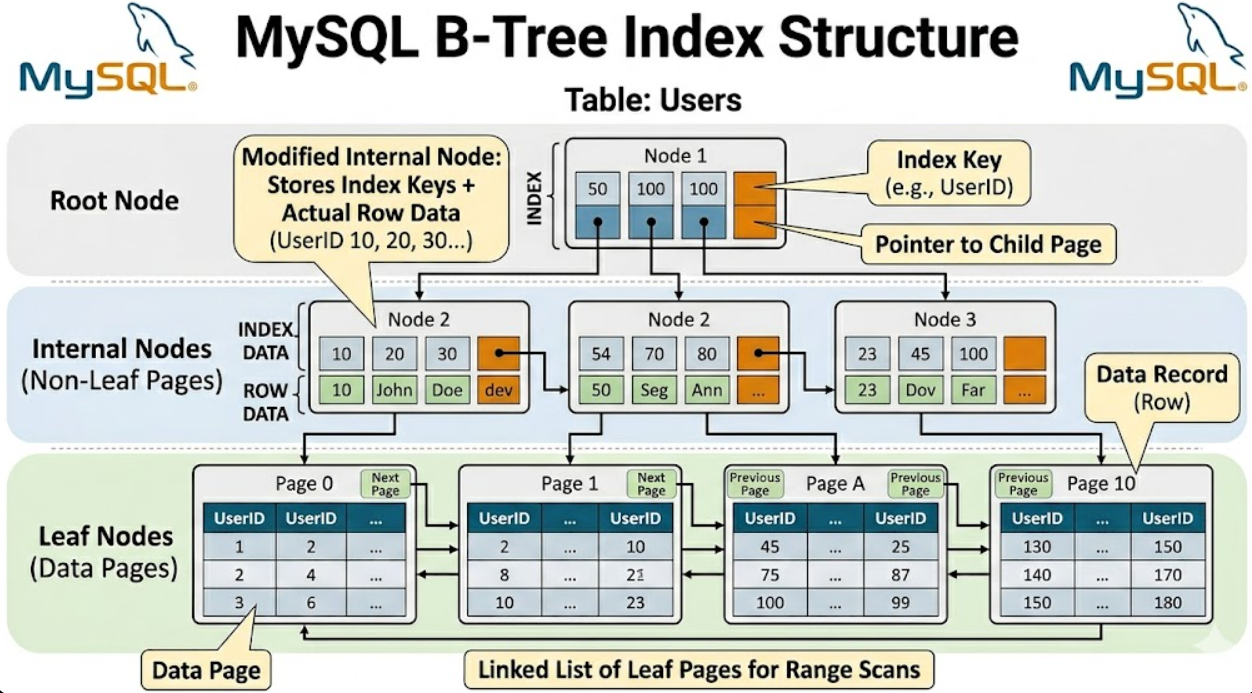
B-Tree and AVL trees are both types of self-balancing binary search trees, but they have different structures and use cases. B-Tree indexes are designed for efficient storage and retrieval of data in databases, while AVL trees are primarily used in memory for fast access to data. B-Tree indexes can have multiple keys and pointers in each node, allowing for efficient searching and insertion, while AVL trees maintain a strict balance condition to ensure logarithmic time complexity for search, insertion, and deletion operations.
Hash Indexes
Hash indexes use a hash function to map the indexed values to a specific location in the index. Hash indexes are very fast for equality queries, as they can directly access the relevant data based on the hash value. However, they are not suitable for range queries or sorting operations, as the hash function does not preserve the order of the indexed values. Hash indexes are only supported by the Memory storage engine in MySQL.
When creating a hash index, you can specify the columns to be indexed and the type of index to be created. For example:1
CREATE INDEX idx_name ON table_name (column_name) USING HASH;
B+Tree Indexes
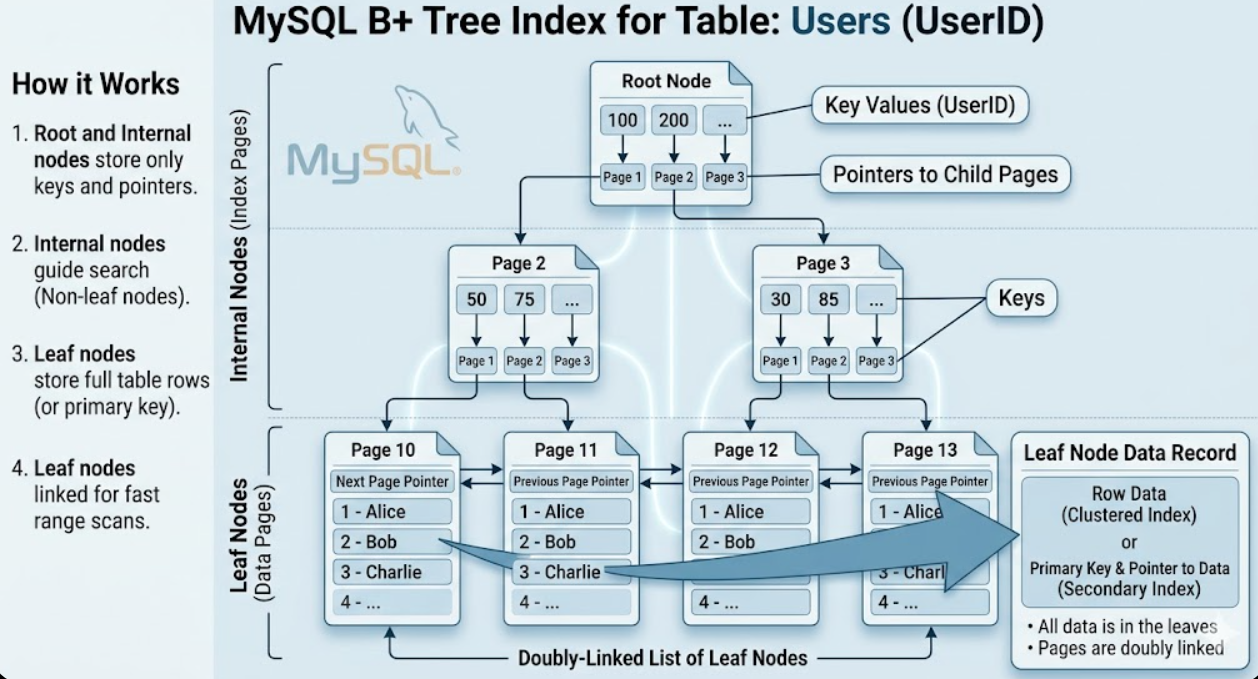
B+Tree indexes are a variation of B-Tree indexes that store all the indexed values in the leaf nodes of the tree, while the internal nodes only contain keys and pointers to the child nodes. This structure allows for efficient range queries and sorting operations, as the leaf nodes are linked together in a sorted order. B+Tree indexes are commonly used in databases to improve query performance for a wide range of queries.
When creating a B+Tree index, you can specify the columns to be indexed and the type of index to be created. For example:1
CREATE INDEX idx_name ON table_name (column_name) USING BTREE;
1 | -- Structure of a B+Tree index |
Full-Text Indexes
Full-text indexes are used for full-text searching in MySQL. They allow you to perform complex searches on text data, such as searching for specific words or phrases within a column. Full-text indexes are supported by both the InnoDB and MyISAM storage engines in MySQL.
When creating a full-text index, you can specify the columns to be indexed and the type of index to be created. For example:1
CREATE FULLTEXT INDEX idx_name ON table_name (column_name);