Github Action with Azure
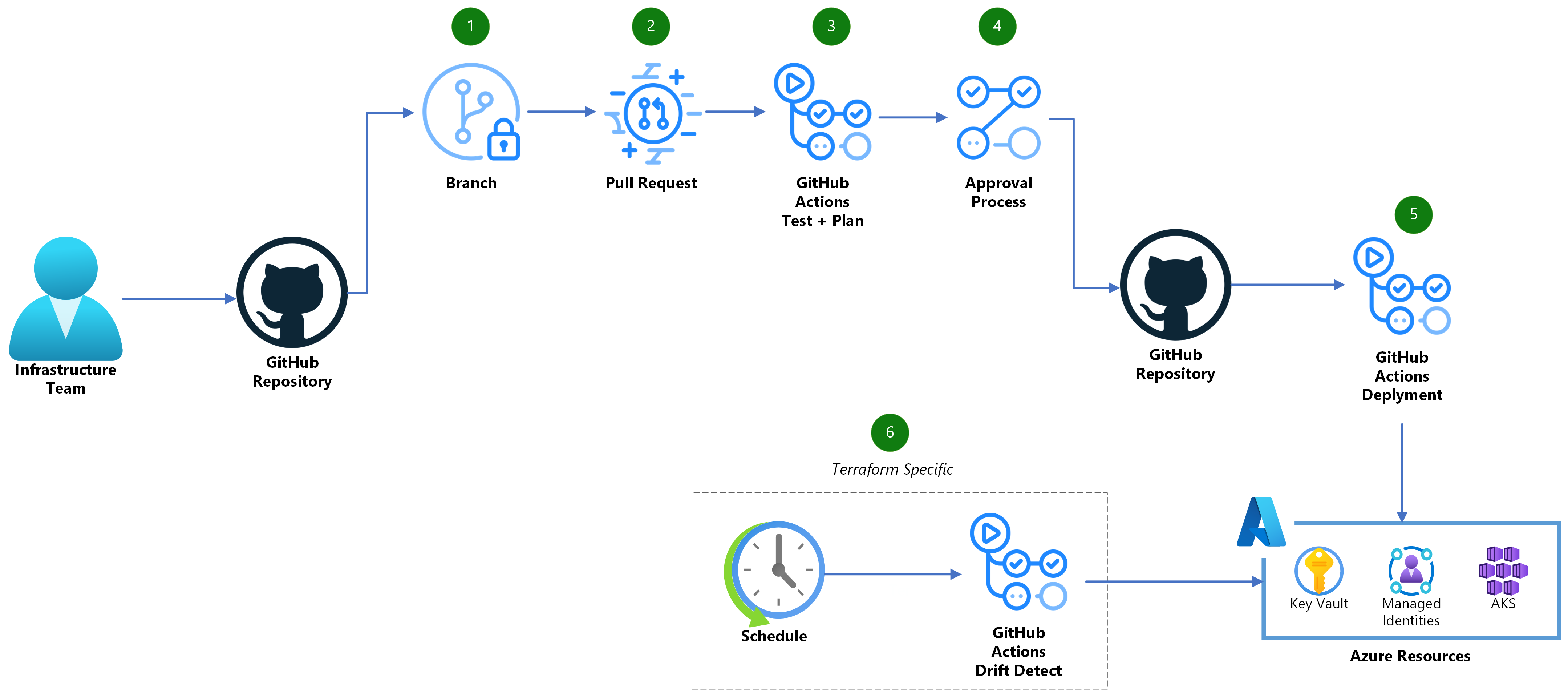
Github Action with AzureIn this post, I will demonstrate a pipeline that is triggered only when code is pushed to the testing or main branch. The pipeline includes static code analysis, unit testing, and an image vulnerability scan. After these checks, the container image is deployed to Azure Kubernetes Service (AKS). Proccess Code RepoCode Repo Features Dev Backend Code checks - Code Analysis, Test UAT Backend CI - Test, Build, and Deploy to UAT PROD Backend CD - Deploy Backend Services to A...

Stack
StackA stack is a linear data structure that follows the Last In, First Out (LIFO) principle. It allows for adding and removing elements in a specific order, where the last element added is the first one to be removed. 123456789101112131415161718192021222324252627class Stack: def __init__(self): self.__items = [] def __str__(self): return str(self.__items) @property def size(self): return len(self.__items) def is_empty(self): return len(self.__items)...

LinkedList
LinkedListA linked list is a linear data structure that consists of a sequence of nodes, where each node contains data and a reference (or link) to the next node in the sequence. Unlike arrays, linked lists do not require contiguous memory allocation, allowing for dynamic memory usage and efficient insertion and deletion operations. the props of linked list: Dynamic size: Linked lists can grow or shrink in size as needed, without the need for contiguous memory allocation. Efficient insertion...

Array
ArrayArray is a linear data structure that stores elements in contiguous memory locations. Each element can be accessed directly using its index, which allows for efficient retrieval and modification. 123456789101112131415161718192021222324252627282930313233343536373839404142434445464748495051525354555657585960616263646566676869class Array: def __init__(self,capacity =8): self.__capacity = capacity self.__size = 0 self.__items = [0] * capacity def __str__(self): arr_str = "...

Azure Container registries
After building our artifacts, we need a place to store them. Common options include Docker Hub, Nexus Repository, Google Container Registry, and Amazon Elastic Container Registry. In this section, we’ll focus on Azure Container Registry (ACR). Creating an Azure Container Registry Select the appropriate Resource Group. Enter a unique Registry Name. Leave all other settings at their default values and proceed with the creation. Configure Credentials for Local Container ManagementThere are two...

Data Warehouse Concept
Data Warehouse ConceptWhat is Data Warehouse?Data Warehouse is a system that stores and processes large amounts of data from multiple sources to provide a single source of truth for business intelligence. It is a collection of data from various sources, including transactional systems, analytical systems, and data sources such as social media, web logs, and customer feedback. The data is transformed, cleaned, and loaded into a central repository for analysis and reporting. Data Warehouse is a...
Physical layer
Physical LayerThe physical layer is the lowest layer in the OSI reference model. It is responsible for the transmission of raw bits over a physical medium, defining the electrical, optical, or wireless signaling that carries the data. Its functions include bit-level transmission, modulation, synchronization, and dealing with noise and interference. 1. Basic Concepts of the Physical Layer Defines the hardware means of sending and receiving data (cables, switches, radios, etc.). Transmits dat...
Physical layer
Physical Layer OverviewThe physical layer is the lowest layer in the OSI model. It is responsible for the actual transmission of raw bits across the physical medium. It defines hardware specifications, signaling methods, transmission rates, and physical connections. In short, the physical layer converts digital data into signals suitable for the transmission medium. Basic Concepts of the Network LayerAlthough the physical layer is the foundation, it works closely with the network layer above ...
DHCP Protocol & DHCP Spoofing Experiment
DHCP Protocol & DHCP SpoofingObjectiveThis experiment aims to observe abnormal behavior in the DHCP protocol by building a simpleLAN topology using Mininet and launching a DHCP spoofing attack with DHCPig [1]. Environment Component Name Version Ubuntu 18.04.1 Mininet 2.3.1b4 DHCPig - isc-dhcp-server[2] - Python3 3.6.9 Network Topology Illustration: The host 1 will act as the DHCP server; The host 2 will act as the client; The host 3 will act as the attacker. Experimen...
DHCP Protocol & DHCP Spoofing
DHCP Protocol & DHCP SpoofingDHCP Protocol OverviewThe Dynamic Host Configuration Protocol (DHCP) is a network management protocol used onIP networks to automatically assign IP addresses and other configuration parameters to devicesusing a client-server model [1]. Layer: DHCP operates at the Application layer in the TCP/IP model and uses UDP as itstransport protocol [2].Ports: The server uses UDP port 67, and the client uses UDP port 68 [2]. Primary Function Automatic IP Configuration: ...