Evolze - Equipment Repair Management System
Evolze is an engineering solutions company that provides innovative and sustainable engineering services across different industries.
In this project, I was responsible for the end-to-end design and development of an Equipment Repair Management System, covering business process design, system architecture, frontend and backend development, database design, workflow automation, security, and deployment preparation.
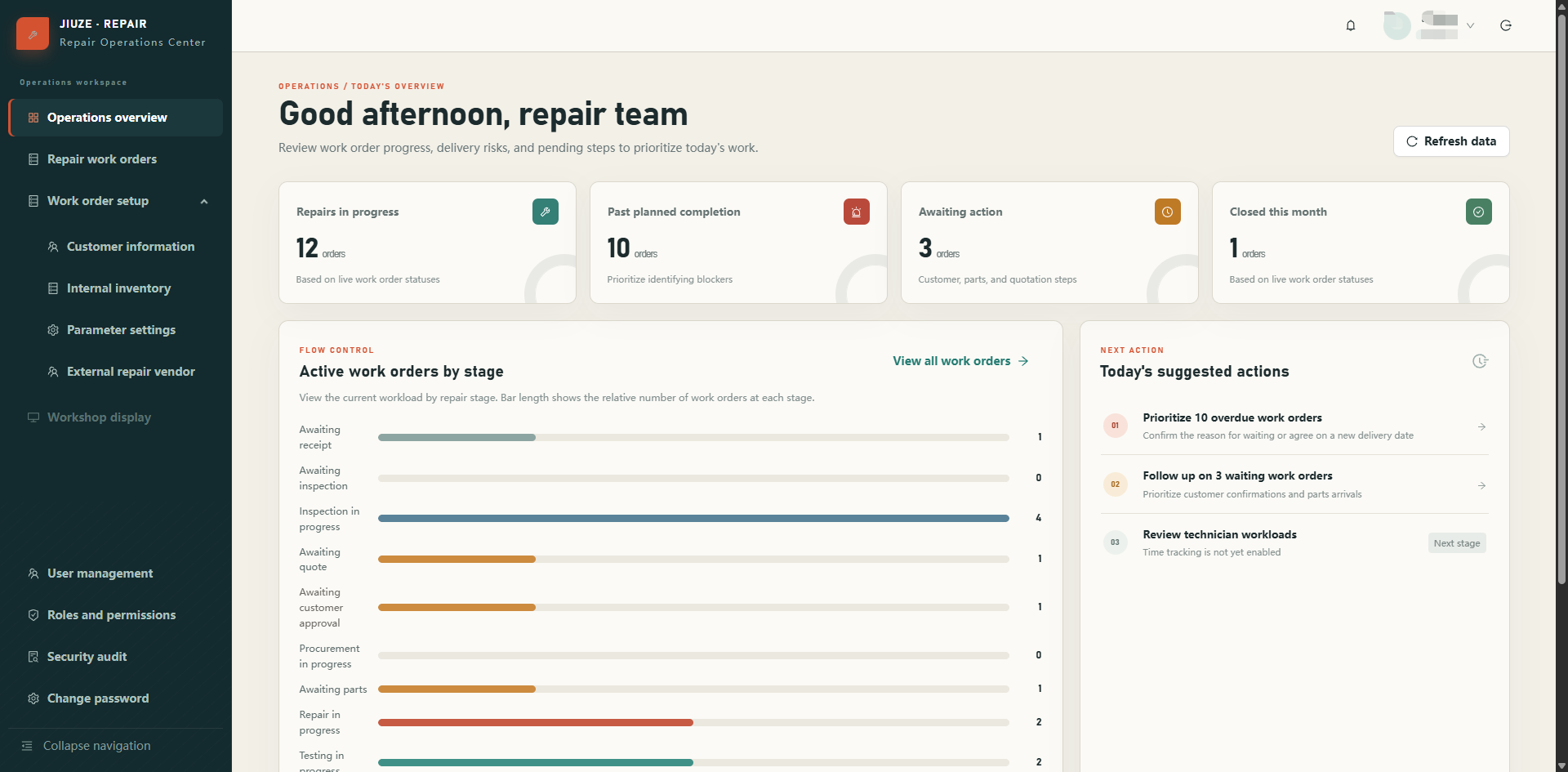
The system provides a centralized platform for managing equipment repair operations, enabling teams to track the complete repair lifecycle, manage maintenance tasks, maintain repair histories, and improve operational visibility.
Link: Evolze
Project Background
Traditional equipment repair operations involve multiple business stages, including equipment receiving, inspection, fault diagnosis, quotation, spare parts management, repair, testing, and delivery.
Managing these activities across different teams requires clear business processes, consistent information management, and reliable tracking of repair progress.
The project aimed to develop an integrated repair operations platform to:
- Standardize the complete equipment repair lifecycle.
- Centralize repair orders, equipment information, and maintenance records.
- Improve visibility into repair status and task assignments.
- Support different repair scenarios, including internal repairs, external repairs, spare parts replenishment, and rework.
- Maintain complete operation histories and audit trails.
- Provide a modular foundation for future system integrations and business expansion.
The initial implementation focused on establishing the core repair workflow and supporting business functions.
System Architecture
The application was designed using a modular full-stack architecture, separating frontend presentation, backend business logic, workflow orchestration, and data persistence.
Overall System Architecture
The system consists of the following major components:
Frontend Application
- React 19 and TypeScript
- Ant Design 6
- Repair order management
- Operational dashboard
- Workflow task management
- Dynamic business process forms
Backend Application
- Java 21 and Spring Boot 4
- RESTful API services
- Business logic and validation
- Transaction management
- Spring Security and RBAC
- Authentication and authorization
Workflow Engine
- Flowable 8
- BPMN 2.0 process definitions
- Workflow task assignment and execution
- Business state transitions
- Repair process history
Data Storage
- PostgreSQL
- Spring Data JPA
- Flyway database migrations
Infrastructure and Integration
- Feishu OAuth authentication
- Alibaba Cloud OSS integration
- Structured application logging
- API documentation and health monitoring
Business Process Architecture
The repair workflow covers the complete lifecycle:1
Equipment Receiving → Inspection → Fault Diagnosis → Quotation → Customer Confirmation → Spare Parts Preparation → Repair → Testing → Shipping → Closure
The workflow also supports additional business scenarios:
- Internal and external repair processes
- Spare parts replenishment and inventory consumption
- Failed testing and return-to-repair workflows
- Returned equipment and linked rework orders
Flowable BPMN was introduced to manage workflow execution and ensure that repair tasks follow valid business transitions.
My Role
I was responsible for the complete business process implementation and full-stack development of the Equipment Repair Management System.
Key Contributions
- Analyzing business requirements and designing the repair lifecycle.
- Designing the application architecture and database structure.
- Implementing frontend interfaces and backend services.
- Designing and implementing BPMN workflows using Flowable.
- Developing repair order management, task processing, inventory operations, and quotation workflows.
- Implementing authentication, authorization, and role-based access control.
- Managing data consistency, workflow validation, and operation history.
- Preparing application packaging, local deployment, and supporting infrastructure integration.
Deployment and Rollback Plan
- Configured Docker for containerized deployment of frontend and backend applications.
- Developed application packaging scripts for frontend and backend releases.
- Integrated automated formatting, linting, type checking, and test validation into the build process.
- Implemented structured JSON logging and request tracing.
- Configured Swagger documentation and application health endpoints.
- Prepared the application for Alibaba Cloud deployment and further infrastructure integration.
Technical Highlights
- End-to-end full-stack application development
- Complex business process modeling using BPMN 2.0
- Workflow automation and task orchestration with Flowable
- Modular backend architecture using Spring Boot
- React and TypeScript enterprise application development
- Transaction management and data consistency
- Concurrency control and idempotent business operations
- Role-based access control and enterprise authentication
- Repair inventory and quotation management
- PostgreSQL database design and migration management
- Secure attachment storage and Alibaba Cloud integration
- Docker-based deployment and automated build validation